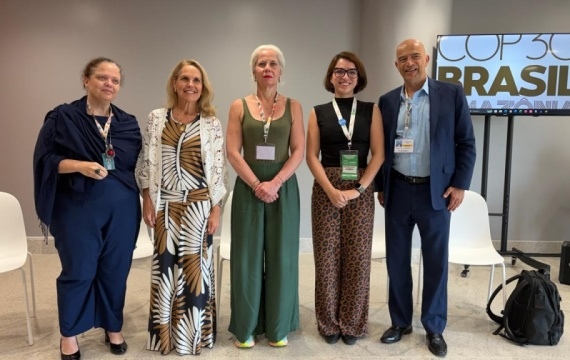
How can cities prepare to face extreme climate events? This was the central question of the panel “Resilient Cities: Finance, Insurance, and Policies to Face Climate Catastrophes”, held on November 12 in the COP30 Green Zone.
Topics discussed included the implementation of municipal-level public policies aimed at increasing city resilience, the role of insurers in risk mapping and pricing, and the role of development banks in financing investments for urban development, including sustainable practices such as water loss reduction and reuse, smart drainage, and solid waste treatment.
Panel participants included Gesner Oliveira, researcher at the FGV Institute for Innovation in Insurance and Reinsurance (FGV IISR); Luciene Machado, Superintendent of Urban Solutions at the Brazilian Development Bank (BNDES); Marianah Villela, Superintendent of Institutional Relations at the National Confederation of Insurers (CNseg); and Patricia Freitas, President and CEO of Prudential do Brasil; moderated by Goret Paulo, FGV’s Director of Research and Innovation.
On the occasion, Gesner Oliveira presented the project “A Municipal Strategy for Adaptation and Mitigation of Climate Extremes”, which proposes a practical guide to help municipal managers integrate the climate agenda into local strategic plans.
“The main focus of this project is municipalities. We want to protect cities, and to do that, we brought together a multidisciplinary team to offer concrete solutions,” said the professor. According to Oliveira, the guide aims to create a conceptual framework to guide best practices and facilitate dialogue between municipalities and the insurance industry.
The researcher also highlighted the lack of planning in most Brazilian cities: “Dialogue with managers revealed that, in many cases, there isn’t even a basic contingency plan for extreme events. Only 5% of municipalities have a stormwater management plan, which is alarming given the growing risk of floods.”
The report prepared by the FGV team emphasizes three key points: climate infrastructure, environmental sanitation, and parametric insurance as tools to face catastrophes. “We show how practices such as water reuse can reduce risks and, consequently, lower insurance premiums and prices,” said the professor.
The guide is already being tested in the municipality of Ribeirão Preto, serving as a model for other cities. A presentation on the project can be accessed by clicking here.
Full coverage of Fundação Getulio Vargas’ participation in COP30, including agendas, exclusive content, and contributions from the institution’s researchers to global climate action, is available on the FGV Climate Agenda Platform. The opinions expressed in this publication are the sole responsibility of the contributing researchers and do not necessarily reflect the official position of Fundação Getulio Vargas.