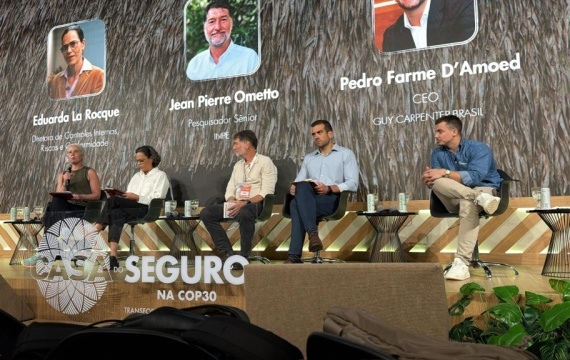
The impact of climate change on the insurance sector was the central theme of the panel “Climate’s Impact on the Insurance Sector”, held on November 14 at the Casa do Seguro. Experts discussed how the increasing frequency and intensity of extreme weather events challenge the industry, demanding new risk management strategies, product innovation, and financing mechanisms to ensure resilience and sustainability.
Goret Paulo, Director of Research and Innovation at Fundação Getulio Vargas (FGV), opened the debate by emphasizing the relevance of the topic:
"Since my first day here at COP30, I’ve noticed that the issues addressed often represent major opportunities for the insurance industry, because in every discussion about the impact of climate change we identify areas of intersection with the sector," said Goret, who moderated the debate.
The director reiterated that examples of extreme weather events are becoming much more frequent and intense in Brazil:
"These phenomena generate lasting impacts on physical and mental health, as well as material losses and disruptions to livelihoods."
Goret also highlighted critical information gaps and the impact of climate change on health:
"In Brazil, there is no data collection on the impact of heat waves. We don’t know the threshold or definition: at what temperature will we see health impacts or fatalities? This reinforces the importance of data collection, storage, processing, and analysis. We also need to consider infectious diseases, which tend to increase with deforestation and climate change."
Among the solutions presented, the director highlighted proposals from FGV researchers working in strategic areas such as social housing:
"Vulnerable areas are the most affected by climate change, and people living in these regions are candidates for social housing—a segment that is underdeveloped in Brazil. FGV researchers have developed a model involving fintechs and insurance to guarantee rent payments, reducing risks for landlords and utilizing vacant properties near productive centers. This reduces commuting, emissions, and improves quality of life."
In addition to social housing, the carbon market and insurance for major catastrophes were also identified as strategic opportunities:
"One of the key elements missing for the development of Brazil’s carbon market is insurance, which can improve risk identification and allocation. A group of FGV researchers developed a model that includes insurance for major catastrophes and preventive measures by cities. Cities adopting resilience practices will pay lower premiums and have greater access to financing."
The director stressed that, given public sector budget constraints, mechanisms such as blended finance and insurance are essential to make these solutions viable.
The discussion was expanded by Eduarda La Rocque, Director of the Brazilian Reinsurance Institute (IRB(Re)), who warned about the country’s lag in protection:
"Over the past 33 years, climate disasters have increased fivefold, generating significant climate injustice. We need to unite the sophisticated models of the insurance and capital markets with the public and private sectors, academia, and regulators. Brazil has a huge protection gap."
From the academic side, Jean Pierre Ometto, Senior Researcher at the National Institute for Space Research (INPE), presented the AdaptaBrasil platform, which integrates climate and social vulnerability data. He highlighted the challenge of incorporating climate issues into risk analyses:
"The analyses conducted by the insurance sector are outstanding; the challenge is to insert this climate layer. A heat wave is not a one-off event, but a typhoon is. How do we map and project this? The idea of this tool is to bring this element of climate uncertainty into the socio-structural context of the country, which has continental diversity."
The economic dimension of risks was highlighted by Pedro Farme, CEO of Guy Carpenter:
"The UN reported that 2024 ended with $320 billion in losses from natural events. In other words, the world loses a ‘Brazil’ every year—the eighth-largest economy—due to these events. Last year, we brought to Brazil the first probabilistic and statistical model for natural catastrophes. After one year, we have already secured an additional R$6 billion in catastrophic reinsurance for the country."
Finally, Pedro Werneck, Sustainability Manager at CNseg, celebrated progress on the global agenda:
"CNseg came to COP30 with the goal of including insurance in the global climate agenda, and it appears we have achieved that goal. We want insurance to appear in the leaders’ final declaration, generating positive repercussions in national and international markets and encouraging new products and socially and environmentally responsible practices."
Watch the full debate by clicking here.
Comprehensive coverage of FGV researchers’ participation at COP30—including agendas, exclusive content, and their contributions to global climate action—is available on the Agenda do Clima FGV platform. The opinions expressed in this publication are solely those of the contributing researchers and do not necessarily reflect the official position of Fundação Getulio Vargas.