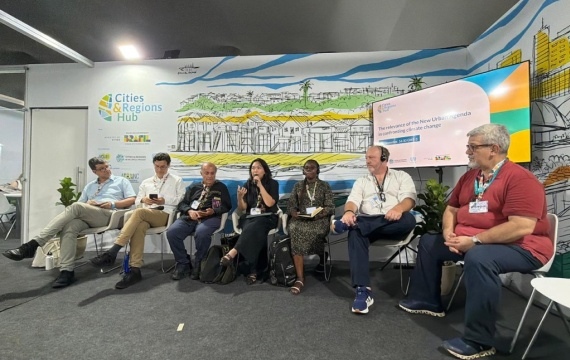
On November 15, José Antônio Puppim, researcher at the São Paulo School of Business Administration at Fundação Getulio Vargas (FGV EAESP), participated in the panel “The Relevance of the New Urban Agenda in Confronting Climate Change”, held at the Cities and Regions Hub, in the Blue Zone, during COP30.
The session addressed the convergence between climate and urban agendas, a central theme ahead of the New Urban Agenda review, scheduled for 2026, marking ten years since its adoption in Quito. According to Puppim, the goal was to understand how to align initiatives such as IPCC Cities, the New Urban Agenda, and the Climate Convention, creating synergies to tackle global challenges.
“In the Brazilian context, we discussed the capacity of municipalities, particularly, to implement this agenda and how we can build these capacities locally. A multi-level arrangement will be necessary, as many municipalities lack the experience and structure to do so. We also discussed what would be the best institutional framework to enable the implementation of this agenda,” emphasized Puppim, who coordinates FGV Earth, a Center for Innovation, Research, and Dissemination (CEPID) on Global Environmental Governance.
The panel reinforced that integrating urban and climate policies is essential to ensure more resilient and sustainable cities, requiring cooperation across different levels of government and new institutional models.
Full coverage of Fundação Getulio Vargas’ participation in COP30, including agendas, exclusive content, and contributions from the institution’s researchers to global climate action, is available on the FGV Climate Agenda Platform. The opinions expressed in this publication are the sole responsibility of the contributing researchers and do not necessarily reflect the official position of Fundação Getulio Vargas.