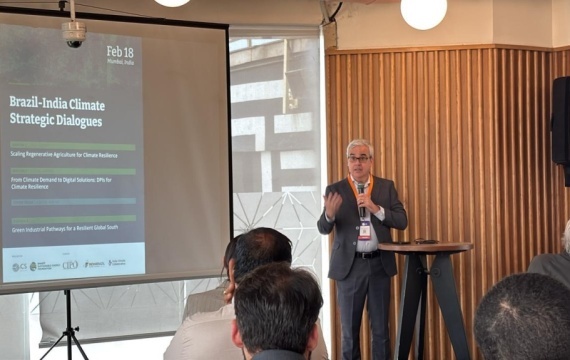
Guilherme Bastos, researcher at Fundação Getulio Vargas and coordinator of the Center for Agribusiness Studies (FGV Agro), was part of the official Brazil–India mission held between February 15 and 21, 2026, representing the Foundation in two of the most important international events on sustainability, energy transition, and economic cooperation in the Global South: the Mumbai Climate Week, in Mumbai, and the India–Brazil Business Forum, in New Delhi.
The mission aimed to expand bilateral cooperation in areas such as agriculture, bioenergy, food security, technological innovation, and climate finance, at a moment of growing strategic convergence between the two countries.
Debates on sustainability and urban challenges marked the agenda in Mumbai
The program in Mumbai began on February 15 with a field visit to vulnerable urban areas of the Indian metropolis. The FGV researcher followed analyses on housing policy, land regularization, and urban sustainability, focusing on landfills, tanneries, informal housing, and local experiences in social inclusion and environmental resilience.
On the following day, February 16, the FGV representative took part in institutional meetings with major Indian conglomerates. During the meeting with the Tata Group, discussions covered the company’s commitments to achieving climate neutrality by 2045, as well as projects on circular economy, green hydrogen, bioenergy, and carbon capture. Opportunities for partnerships with Brazil to expand the supply of sustainable aviation fuels (SAF) were also explored — a priority topic to meet the goals of the international CORSIA scheme.
Also in Mumbai, the researcher joined the meeting with UPL OpenAg, focused on agricultural initiatives aligned with the BRICS Business Council. Topics discussed included regenerative agriculture, fertilizer-use efficiency, and digital platforms for productive and environmental monitoring — areas in which Brazil is considered a strategic partner, especially regarding the adoption of these solutions by agricultural cooperatives.
The technical agenda concluded on February 17 with debates on sustainable agriculture and community resilience. The researcher attended presentations on Indian experiences in landscape management, community water governance, and rural development, including the work of the Pani Foundation and the Pokra Project. Regulatory bottlenecks, data interoperability, and the role of women in sustainable agriculture were also discussed.
FGV represents Brazil in strategic panels at the India–Brazil Business Forum
The next stage of the mission took place in New Delhi during the India–Brazil Business Forum on February 21. The event was attended by the President of the Republic, government authorities, business leaders, and institutions from both countries to strengthen commercial, industrial, and technological cooperation.
Bastos joined the Brazilian delegation present at the opening session, which featured representatives from FICCI, ApexBrasil, CNI, and the ministries of Trade and Foreign Affairs of Brazil and India.
According to the researcher, the tone of the speeches highlighted the growing importance of the bilateral relationship in global geopolitics, particularly in areas such as energy transition, innovation, and food security.
“Throughout the forum, I followed key debates for the bilateral agenda. In the panel on Technology, Innovation, and Critical Minerals, we discussed strategic industrial value chains alongside companies such as Embraer, Vale, WEG, and Tata Consultancy Services. In the Biofuels and Energy Transition panel, the central role of ethanol and SAF in Brazil–India cooperation became clear, in a discussion that brought together Petrobras, UNICA, Praj Industries, and Renuka Sugars,” Bastos stated.
The forum also included discussions on health and the pharmaceutical supply chain, agricultural innovation and food security, and family farming and rural livelihoods, with the participation of Brazilian cooperatives, Indian organizations such as IFFCO and NAFED, and representatives from Brazil’s Ministry of Agrarian Development.
The program concluded with the signing of Memorandums of Understanding reinforcing bilateral commitments, in addition to a plenary session with business leaders.
Strategic cooperation in sustainability and innovation
According to the researcher, the mission reinforced the convergence between Brazil and India on key themes for sustainable development, including bioenergy, regenerative agriculture, fertilizer efficiency, and digital agricultural platforms.
“It is important to strengthen FGV’s institutional presence in the international debate on sustainability, in order to expand opportunities for technical cooperation between the countries,” he concluded.