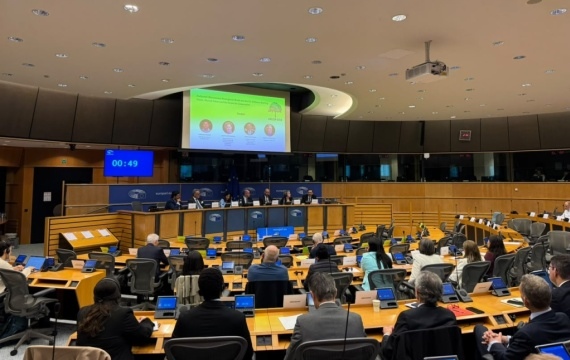
On June 4, Brussels — the political center of Europe — became the stage for Amazon Week 2026, a strategic initiative led by Brazil’s Mission to the European Union and ApexBrasil to promote sustainable trade and forest preservation. The event brought together political leaders and experts to discuss how to transform biodiversity into a global economic asset.
The panels were divided between the European Parliament, focused on enabling development models for small producers, and the Berlaymont Building of the European Commission, where the central theme was financing and risk reduction for bioeconomy projects.
Fundação Getulio Vargas (FGV) contributed scientific evidence to the debate through Marcelo Behar, researcher and coordinator of the Climate Governance Forum at FGV’s São Paulo Law School, who also serves as Special Envoy for Bioeconomy at COP30.
Behar was one of the main speakers at the assemblies, while André Portela, coordinator of the Center for Applied Microeconomics (C-Micro), and Guilherme Bastos, coordinator of the Center for Agribusiness Studies (FGV Agro), joined the discussions, consolidating FGV’s role as a bridge between scientific knowledge production and the implementation of international public policies.
Social Inclusion and “Roadmaps” at the European Parliament
At the European Parliament, the discussion focused on how to ensure that bioeconomy is not just an abstract concept but a reality that increases the income of those living in the forest. Marcelo Behar presented a systemic vision of bioeconomy as the only path to sustain the world’s $100 trillion GDP while simultaneously halting the annual deforestation of 11 million hectares.
For Behar, implementation depends on three pillars: “roadmaps” for decarbonization, direct action against deforestation, and democratization of finance. He emphasized: “The third issue is how we manage to bring finance to the grassroots, reaching small producers.” He also called for a radical shift in perception of local populations: “Traditional communities are not poor peoples left on the margins of development; they are guardians of the forest, true holders of global nature, as they safeguard 80% of the world’s biodiversity.”
The need for scale for small producers was reinforced by Laudemir Müller, president of ApexBrasil, who highlighted that “70% of Brazil’s agricultural sector is made up of family farming” and that conscious trade is key to sustainable development. This perspective was humanized by the testimony of Maria do Socorro Teixeira Lima, president of the Association of Rural Women Workers of Bico do Papagaio, who described extractivism as a pillar of health and life: “Babassu is part of our economy and integrates the bioeconomy. For us, the Amazon is life. It is life, income, and food.”
You can view the entire assembly by clicking here.
Debate at the Berlaymont Building: from carbon to financing standing forests
At the Berlaymont Building, headquarters of the European Commission, the focus shifted to the financial architecture needed to sustain the bioeconomy. On that occasion, Marcelo Behar stressed that fragmented technical criteria are a major obstacle: “There is still a lack of dialogue between Brazil and EU frameworks to establish common metrics for nature and emissions. In carbon emissions alone, we are talking about 132 different metrics.”
Behar proposed that climate communication must be more empathetic to mobilize society and the private sector: “We need to move from ‘carbon emissions’ to ‘carbon emotions.’ We must explain to people how to bring a solution that simultaneously reduces emissions, restores nature, and distributes resources.” He mentioned the Tropical Forest Forever Facility (TFF) fund as a concrete mechanism to reward preservation, exemplifying that the Yanomami community could receive $36 million per year simply for maintaining its territory.
The European Union’s executive branch responded with the presentation of investment tools. Roman Garcia, from the European Commission, detailed the role of the Global Gateway, a strategy to create “bankable” and replicable projects. According to Garcia, the initiative seeks to combine subsidies and guarantees to reduce risks, attract investments, and mobilize the private sector, with Brazil’s forest bioeconomy as a shared priority.