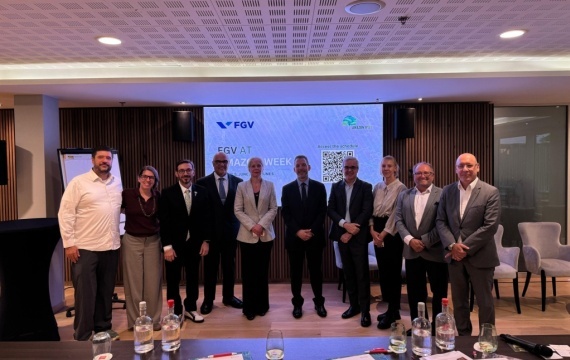
Between June 1 and 6, 2026, the cities of Brussels, Paris, Berlin, and London hosted the fourth edition of Amazon Week, a strategic initiative of Brazil’s Ministry of Foreign Affairs (Itamaraty). In this edition, the event featured a stronger presence from the academic sector, led by Fundação Getulio Vargas (FGV), which organized panels in Brussels on June 3 and 5, expanding the space for debates grounded in scientific evidence.
During the opening of the first panel on June 3, Marcel Botelho, President of the National Council of State Research Support Foundations (Confap), stated that, given the challenges facing the Amazon, it is necessary to consolidate what experts call “Plan B”: a transition from traditional extractive economies to a regenerative and profitable bioeconomy that prioritizes the well-being of local populations.
“The challenge lies in ensuring that economic benefits reach the ground level, directly impacting residents of the poorest and most vulnerable inland municipalities,” Botelho emphasized.
Panel 1: Metrics, Markets, and the Urgency of Conservation
Titled “Carbon, Conservation, and Sustainable Agricultural and Livestock Systems,” the first panel sought to explore pathways to align agricultural production growth with environmental preservation under robust governance. The session underscored that the Amazon is the world’s largest carbon reservoir, and maintaining the forest is a sine qua non condition for fulfilling the Paris Agreement.
Marcelo Behar, an FGV researcher and Special Envoy for Bioeconomy at COP30, warned that “all the carbon stored in the Amazon is equivalent to all the carbon emitted by the United States since the Industrial Revolution.”
Complementing the technical perspective, Guilherme Bastos, coordinator of the Center for Agribusiness Studies (FGV Agro), pointed to land tenure insecurity as one of the greatest economic barriers to forest preservation: more than 50% of large properties in the Amazon lack legal titles, which hinders the development of Environmental Reserve Quota (CRA) and Payment for Environmental Services (PES) markets.
The international perspective on environmental conservation was brought by João Campari, Global Leader at WWF International, who noted that the global food system generates a net loss of USD 11 trillion annually due to unaccounted environmental costs. “Brazil is large enough not to cut down a single additional tree,” Campari stated.
On the opportunities front, Gustavo Ferreira Ribeiro, Head of Market Intelligence at ApexBrasil, reported that the Legal Amazon exports USD 610 million annually in forest-compatible products, but highlighted the difficulty of tracking data in value chains such as açaí and Brazil nuts, which may lead to underestimation of export values.
Finally, Gisele Obara, Director of Trias Brasil, reinforced that the success of this model depends on strengthening cooperativism and promoting the productive inclusion of youth and family farmers, who produce up to 70% of local food. To enable this market, Fernanda Stefani, CEO of 100% Amazônia, advocated for standardized rules for the use of local products as ingredients for global industries, transforming biodiversity into functional assets for cosmetics and supplements.
Panel 2: Science as the Foundation of a Just Transition
The second panel, “Just Transition in the Amazon,” focused on identifying solutions to the paradox of a region rich in natural resources but where most of the population lives in poverty and vulnerability. The session opened with remarks from Brazil’s Ambassador to the European Union, Pedro Miguel da Costa e Silva, who highlighted the complexity of governance challenges in the region.
According to the diplomat, combating social exclusion must be accompanied by institutional rigor: “The issue of poverty and inequality is about finding options for the millions of people who live there. It also, of course, involves enforcing and maintaining the law, combating illegal activities, illegal groups, and transnational crime,” he said, advocating for a coordinated approach between Brazil and the EU.
In addition, Geert Anckaert, from the European Commission (DG INTPA), presented the Global Gateway program, which aims to mobilize €300 billion in sustainable investments, including €20 million recently allocated to the Amazon Fund. Cesar Cunha Campos, director of FGV Europe, emphasized that preserving the Amazon depends on creating a productive economy based on biotechnology and Indigenous knowledge systems.
Goret Paulo, Director of Research and Innovation at FGV, began the panel presentations by showcasing concrete models of innovation. She described the “circular social bioeconomy” model, exemplified by sustainable pirarucu management and the full use of native seeds such as andiroba and murumuru for cosmetics production—both income-generating activities developed and managed by local traditional communities. “We are talking about innovation supported by public policies that respect and value local knowledge.”
The effectiveness of data-driven policies was demonstrated by André Portela, coordinator of FGV Clear, who presented the results of the TeleAmes program. The telehealth initiative reduced the need for arduous overland travel for patients and healthcare professionals, showing how technology can mitigate geographic challenges.
“We believe that research must be strongly connected to public policies to bridge the gap between academic knowledge and government practice.”
Severe climate risks were detailed by José Marengo, researcher at Brazil’s National Center for Monitoring and Early Warning of Natural Disasters (Cemaden) and one of the lead researchers at the Center for Climate Risk and Resilience Studies (FGV CR²). Marengo warned about “tipping points” and the increasing likelihood of some Amazon areas becoming carbon sources.
He urged a broader perspective on the forest: “Do not see the forest merely as a ‘green carpet’; people live there, and there is biodiversity. Everything is connected. If you break these connections, we will face major changes.” He also cautioned that in the event of forest collapse, “you can forget about bioeconomy and everything else,” stressing that conservation is essential to fostering socioeconomic development.
Energy transition was another critical issue. Guilherme Bastos (FGV Agro) highlighted that 96% of isolated systems in the Amazon depend on diesel, at costs ten times higher than the national grid. He argued that replacing diesel with renewable sources could prevent the emission of 1.5 million tons of CO₂ by 2030.
Biodiversity as a strategic asset was addressed by Geraldo Fernandes, researcher at the Federal University of Minas Gerais (UFMG). “Carbon alone may not be sufficient for the Amazon because we need biodiversity. Without biodiversity, we will have an empty forest,” he warned.
He cited the example of green propolis, valued at USD 180,000 per kilogram, stating that “the value of a standing forest must exceed that of deforestation.”
Closing the presentations, Julie Dumont, Scientific Attaché at Wallonie-Bruxelles International, introduced the Gastronom Amazonian project. “The focus here is to promote Amazonian biodiversity and bioeconomy with the goal of integrating these products into local and international markets,” she explained.
Conclusion
In conclusion, the event reinforced the idea that preserving the Amazon requires ethical integration, public policies that enable long-term investment, and, above all, a new model of socioeconomic development—one that respects the knowledge of local traditional communities and preserves natural resources for future generations.
The presentations delivered by experts during the panels organized by FGV at Amazon Week are available at this link.