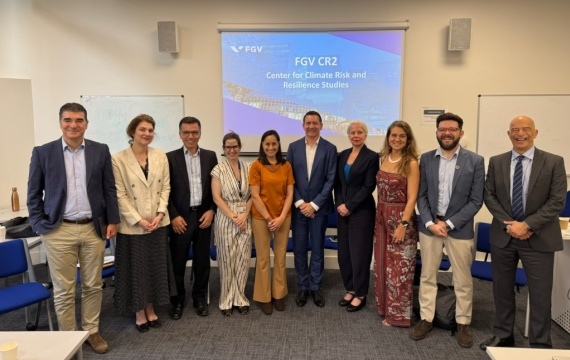
On June 22, Fundação Getulio Vargas (FGV), in collaboration with the National Confederation of Insurers (CNseg), hosted the roundtable “Climate Risk and Resilience” at Queen Mary University of London (QMUL). The meeting, part of the official program of London Climate Action Week 2026, served as a platform to debate the rising climate risks and the actions being planned and implemented worldwide to measure and mitigate these risks.
The central objective of the event was to bring together different sectors—academia, the insurance industry, development banks, and multilateral agencies—in order to discuss how the use of scientific evidence can help design public policies and support the development of innovative solutions for the insurance market. These solutions aim to prepare urban infrastructure to face increasingly intense and frequent climate disasters.
On this occasion, FGV presented a new research center focused on measuring climate risks and supporting the development of public policies and adequate regulation to enable infrastructure consistent with the new climate reality.
Building Bridges Between Academia and the Market
The opening session featured Dyogo Oliveira, President of CNseg, and Goret Paulo, Director of Research and Innovation at FGV. Oliveira initiated the discussion by reflecting on the need for greater dialogue between the insurance market and academia, while Goret Paulo emphasized that the new Center for Climate Risk and Resilience Studies (FGV CR²) seeks precisely “to work jointly with the public and private sectors and involve researchers, master’s and doctoral students, thereby facilitating the transformation of research into innovative solutions for the insurance market.”
FGV CR² was created to integrate climate science, economics, and finance in a scenario where climate disasters have affected more than 336,000 people in Brazil, with estimated economic losses of R$ 3.9 billion, according to CEMADEN—FGV’s partner in CR².
In this context, the Center will produce analytical tools to support the formulation of public policies and regulation; create instruments to measure, manage, and mitigate climate risks; and strengthen Brazil’s institutional capacity to respond to the climate crisis.
This need for practical application was reinforced by Rui Esteves, Technical Director-General of Grupo Fidelidade Portugal and Co-leader of the Impact Center for Climate Change, who detailed an interdisciplinary study on forest fires. According to him, the work involves more than 20 researchers to create robust scientific models to assist policymakers:
“The ultimate goal is to build something that clearly combines risks, exposures, vulnerabilities, and potential losses. We want to go beyond merely identifying physical risks and move toward more concrete estimates of the magnitude of expected losses,” Esteves highlighted, presenting another concrete case of interaction between academia and the market.
Governance Challenges and the Role of Insurance
The discussion then moved into the legal and governance field with Fernando Barrio, Reader in Sustainable Business Law and Policy at QMUL. Barrio argued that climate risk is not only a scientific or financial problem, but fundamentally a governance problem:
“We may have better data, better models, better satellite imagery, better AI systems and more sophisticated insurance products, but unless those instruments are embedded in public policy, institutional capacity and social legitimacy, they will not necessarily produce resilience.”
Franziska Arnold-Dwyer, researcher at University College London (UCL), emphasized the role of insurance, arguing that it must go beyond financial compensation after disasters:
“Insurance should not be only a post-disaster solution. Insurers can act proactively in loss prevention and community preparedness, ensuring humanitarian and economic benefits and strengthening the viability of the market itself in the face of intensifying extreme climate events.”
Urban Planning with a Focus on the Amazon
The interface between science and urban planning was addressed by Thaisa Comelli, researcher at UCL. Comelli stressed that disasters are the result of human decisions:
“Disasters are not natural; they happen because we fail to understand the causal links between decisions and consequences.”
Veronica Galmez, Senior Specialist at the Inter-American Development Bank (IDB), emphasized the urban dimension, which is crucial for the Pan-Amazon region, where 70% of its 50 million inhabitants live in urban areas:
“While we finance the restoration and conservation of Amazon ecosystems, we need to focus on the resilience of urban populations. Cities are economic centers, hubs of resilient infrastructure, and markets to strengthen the Amazon bioeconomy.”
She explained that the IDB, through its umbrella program Amazonia Forever, is also implementing prevention strategies and strengthening early warning systems:
“These precautionary activities aim to build resilience.”
Brazil’s Strategic Role and Development Banks
Fernanda Garavini, Head of the Amazon Fund Management Department at BNDES, stressed that the most important task for a development bank today is to fight the climate crisis:
“With the Climate Fund, we finance resilient urban development, green industry, energy transition, and forest restoration. We increased the annual budget allocation from around 100 million dollars to about 2 billion dollars for investment in these projects.”
Garavini also reiterated the need for integration among different sectors to solve the climate crisis:
“We need to unite private and public actors. We must bring the insurance sector and also include central banks in these discussions. I believe academic studies will be very useful to help put all this into an equation.”
Representing the UN Global Compact, Rubens Filho, Executive Manager of Sustainability, highlighted business engagement in Brazil. He suggested creating working groups with insurers to discuss the “just transition” and reiterated that one of the main focuses of the Global Compact is mobilizing the private sector:
“In Brazil, we have mobilized 130 companies so far in the Net Zero Ambition Movement to have their targets approved by the SBTi (Science Based Targets initiative).”
He also warned about the need to plan future strategies:
“In terms of adaptation, we work directly with the Brazilian government on the AdaptaBrasil platform, training companies to connect their data and plan their adaptation strategies. We are connected with various networks and organizations to make this possible.”
Adapting Cities to Climate Change
In closing, Gesner Oliveira, researcher at FGV EAESP and lead researcher at FGV CR², presented the importance of data to help cities adapt to climate change:
“We need to integrate joint solutions, such as water reuse and the insurance market, using parametric insurance and securitization to make climate risk more manageable. By enabling risk to be diluted in the capital market through Insurance Risk Bonds (IRBs), we create a robust mechanism to mitigate the impacts of severe droughts and strengthen the resilience of Brazilian cities against extreme climate effects.”
After the initial presentations, the invited experts engaged in a debate with the audience. To follow the activities of FGV CR², visit the website of the Institute of Innovation in Insurance and Reinsurance.