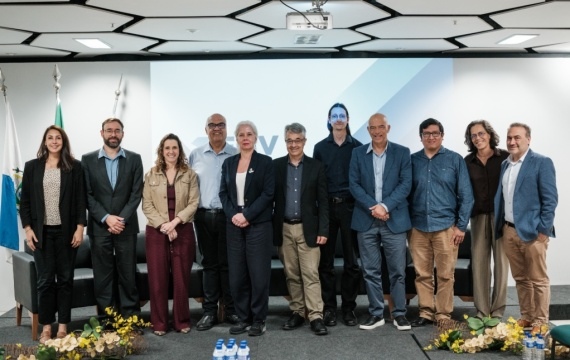
On July 30, in Niterói, researchers and public officials gathered during the 78th Annual Meeting of the Brazilian Society for the Advancement of Science (SBPC) for a roundtable organized by the Center for Studies on Climate Risks and Resilience (FGV CR²).
The meeting took place in the aftermath of a severe windstorm that struck the State of Rio de Janeiro with winds exceeding 100 km/h (more than 50 knots), causing widespread destruction, the closure of the Rio-Niterói Bridge, power outages, disruptions to urban transportation, and loss of life across the metropolitan region. Discussions focused on how technology and institutional coordination can help cities prepare for increasingly frequent and intense extreme weather events.
The main objective of the roundtable was to present and discuss initiatives aimed at aligning research on climate risk modeling, the socioeconomic impacts of extreme events, urban mobility, and the use of Artificial Intelligence (AI) to strengthen territorial resilience and promote cooperation among academia, the public sector, and the private sector.
Resilience in Practice and Public Warning Systems
Niterói Deputy Mayor Isabel Swan highlighted that the city has invested heavily in slope stabilization measures since the Morro do Bumba disaster, with investments totaling more than BRL 1.5 billion. Referring to the recent windstorm, she emphasized the need to improve social response mechanisms:
“Communication with the population began one day in advance, but even so, we effectively need more active communication, hour by hour, so that everyone remains alert and acts collectively.”
Fabiana Leite, Deputy Secretary for Innovation, Science and Technology (SMICT) of Niterói, complemented the discussion from a behavioral economics perspective, noting that citizens do not always respond to warnings:
“Brazilian citizens do not act immediately when an alert is issued. Public policy needs to take into account how citizens make decisions.”
Monitoring and Data Intelligence in Rio de Janeiro
Representing the Rio de Janeiro municipal government, Raquel Flexa, Deputy Secretary for Digital Transformation and Smart Cities at the Civil House, emphasized that the Rio Operations Center (COR), established after the 2010 floods, has become the cornerstone of the city’s resilience strategy.
Speaking about vulnerable neighborhoods located below sea level, she compared Rio’s interventions to techniques adopted in Europe:
“In Jardim Maravilha and Acari, for example, we will create parks and sponge areas to retain water. We are doing what the Netherlands does: Jardim Maravilha will have a dike.”
She also highlighted the importance of long-term infrastructure investments:
“Those who do not know the past cannot appreciate the importance of that infrastructure [the Tijuca flood-control reservoirs]. In the 1990s, I was stranded by floods countless times; today, people can travel through that area with ease.”
The Role of the Federal Government and Academia
Hugo Valadares Siqueira, Director of Incentives for Digital Technologies at Brazil’s Ministry of Science, Technology and Innovation (MCTI), reinforced the importance of nationwide data integration. He noted that Rio de Janeiro is among the country’s most advanced states in digitalization and that the federal government has a strong interest in integrating these models:
“The data belong to Rio de Janeiro, but they can be used to train models in São Paulo, in Goiânia... these are variability models.”
AI was also a central topic for Denis Bruno Virissimo, Manager of the Artificial Intelligence Unit at the Institute for Technological Research (IPT), who stressed the need for transparency in algorithms used in public policy:
“AI models must provide explainability because, ultimately, public policy must also be able to explain to municipalities and citizens why a given action is being taken.”
Technological Solutions and Infrastructure
Raimundo Nonato Damasceno, Director of the Center for Biomass and Water Management Studies (NAB) at the Federal Fluminense University (UFF), presented pyrolysis using green coconut waste as a solution for both waste treatment and clean energy generation:
“Pyrolysis eliminates pathogens and converts biomass into liquid products or carbon,” the professor explained.
Ciro Biderman, Coordinator of FGV Cidades, added that such waste-derived products could, for example, be used to fuel Niterói’s garbage truck fleet.
Conclusion and Next Steps
The event concluded with a shared understanding of the urgency of cross-sector partnerships. Eduarda de La Rocque, Director of Internal Controls, Risk Management and Compliance at IRB(Re), emphasized that data and products must serve the most vulnerable populations:
“The climate crisis affects everyone... and we must develop products and data not for the wealthiest, but for the most vulnerable.”
Goret Paulo, Director of Research and Innovation at Fundação Getulio Vargas, who moderated the discussion, concluded by reinforcing the need for research institutions to support municipal public management in the design and evaluation of public policies through data-driven analyses and recommendations.
The meeting also featured the participation of José Marengo, General Coordinator for Research and Development at the National Center for Monitoring and Early Warning of Natural Disasters (Cemaden); Bernard Salanié, researcher at Columbia University; Gesner Oliveira, professor at the São Paulo School of Business Administration (FGV EAESP); Jorge Luis Poco Medina, professor at the School of Applied Mathematics (FGV EMAp); and Rafael Martins, researcher at the Center for Regulation and Infrastructure Studies (FGV CERI).