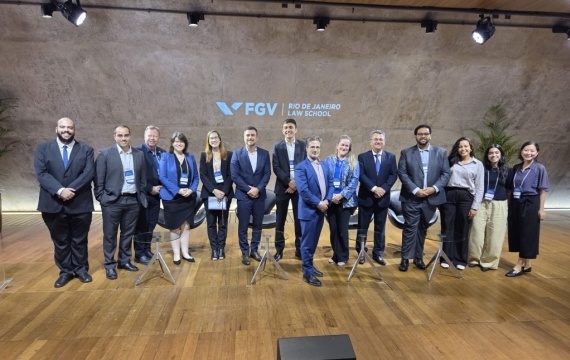
On November 13, the congress “A Mandate for All: the Legal and Civic Imperative to Confront the Climate Emergency”, organized by FGV Direito Rio in partnership with the Elisabeth Haub School of Law at Pace University, brought together specialists in Belém, Rio de Janeiro, and New York for an intense program of debates on the legal and social challenges of the climate crisis.
The opening remarks were delivered by Romulo Sampaio, Pedro Bentes Pinheiro Filho, Michael Wilson, Katrina Kuh, and Sávio Barreto, paving the way for a series of panels featuring jurists, scientists, and representatives from public and private institutions.
The first panel, “The Role of the Judiciary in the Climate Agenda,” explored how courts can influence environmental policies, with contributions from Vinicius Lameira Bernardo, Julio C. M. Borges, Fernanda A. Tanure, Luc Lavrysen, and Umair Saleem, moderated by James R. May.
Next, the panel “Corporate Climate Action: Responsibility and the Path to Net Zero,” moderated by Romulo Sampaio, gathered executives and experts such as Tiago Rodrigues Moura, Márcio Pereira, Alessandra Lehmen, Fábio Flores, and João Irineu Medeiros to discuss business strategies toward carbon neutrality.
In the afternoon, the congress addressed global topics, including “Outcomes of the IUCN World Conservation Congress in Abu Dhabi,” moderated by David M. Forman, with remarks from Richard L. Ottinger, Jojo Mehta, Achinthi Vithanage, and Isabela Vasconcelos Chelou. Another highlight was the panel “The Perspective of Public Advocacy in the Climate Change Agenda,” featuring Leonardo David Quintanilha de Oliveira and Rafael Daudt D’Oliveira.
The event also included discussions on the role of bar associations in ensuring compliance with climate obligations, the importance of “Climate Rehabilitation” for ecosystem restoration, and the challenges of “Climate Finance,” a panel featuring Joaquim Levy and Markus Gehring.
Closing remarks were delivered by Ricardo Mello, David Cassuto, and Romulo Sampaio, emphasizing the urgency of joint action among law, science, and civil society to confront the climate emergency.
The event was supported by Gold sponsors Silveira Athias Advogados and Mattos Filho, along with national and international partners such as IUCN, FGV Europe, and the Climate Law and Governance Initiative.
Full coverage of Fundação Getulio Vargas’ participation in COP30, including agendas, exclusive content, and contributions from the institution’s researchers to global climate action, is available on the Agenda do Clima FGV Platform. The opinions expressed in this publication are solely those of the contributing researchers and do not necessarily reflect the official position of Fundação Getulio Vargas.